
The World Cup in Atlanta: A Conversation with U.S. Soccer CEO JT Batson

Updated: May 26
Published: May 7th, 2026
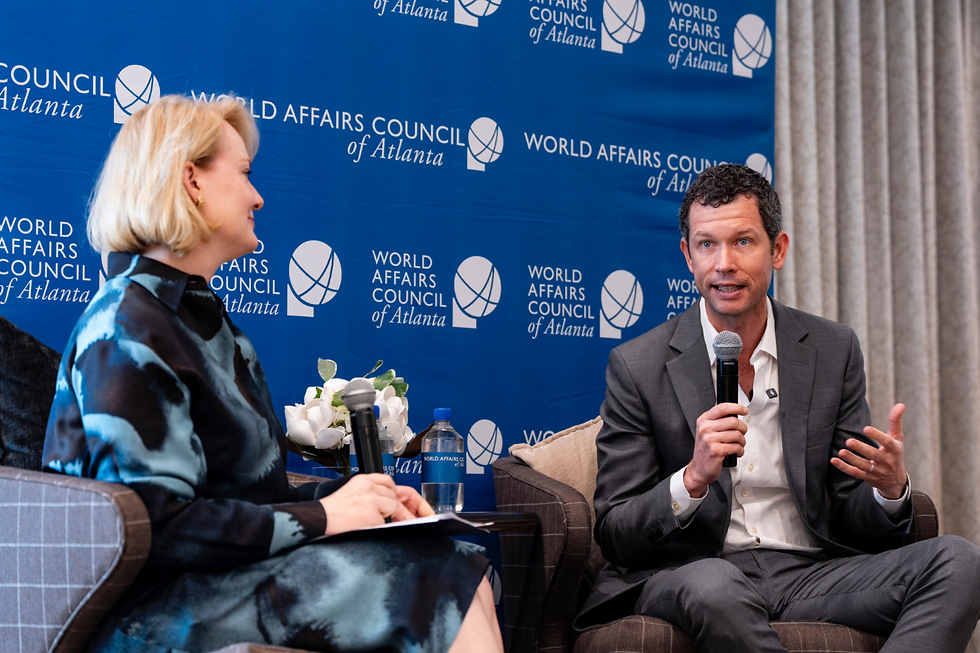
As Atlanta prepares to take center stage for the 2026 FIFA Men’s World Cup, the World Affairs Council of Atlanta convened a fireside chat with JT Batson, Chief Executive Officer of the U.S. Soccer Federation, to examine what that moment represents—for the city, for American soccer, and for the global future of the sport. Council President Rickey Bevington led a wide‑ranging conversation that framed the World Cup not as a standalone event, but as part of a longer arc of leadership, inclusion, and institutional change.
From the opening moments, Batson challenged the notion that U.S. Soccer exists simply to govern competitions or manage national teams. Instead, he described the federation as “in service to soccer,” a posture rooted as much in community impact as in elite performance.
“We want our teams to win World Cups,” Batson said. “We want soccer to be the number one played sport in every community. And we want U.S. Soccer to be yours.”
That third ambition—belonging—served as a throughline for the conversation, surfacing repeatedly as Batson moved between topics as varied as youth participation, talent development, disability inclusion, and global competitiveness.
Building an Institution That Matches the Moment
Batson outlined U.S. Soccer as a uniquely complex organization, one that simultaneously functions as a professional sports enterprise, a standards‑setting body, and a social impact institution. Running world‑class national teams requires elite athletes and coaches. Supporting the broader ecosystem requires referee development, coaching education, and governance. Expanding access requires partnerships with schools, municipalities, and nonprofits.
“All of that exists inside one organization,” he said, “and it has to work together if we want soccer to thrive at every level.”
That integrated vision shaped the decision to relocate U.S. Soccer’s headquarters and build a national training center in metro Atlanta. When Bevington asked why Atlanta emerged over other major cities, Batson pointed first to the region’s ability to coordinate across sectors.
“Atlanta likes to come together to do big things,” he said. Delivering a national headquarters and training center at the scale U.S. Soccer envisioned, he explained, required state and local government, business leaders, and philanthropies moving in alignment—and Atlanta made that possible.
Equally important was the city’s growing appeal as a global destination for talent. Soccer, Batson emphasized, is the most competitive labor market in sports, with professionals able to work anywhere in the world. To compete, U.S. Soccer needed to be located where people want to live, not just work.
“Our talent can literally work anywhere,” he said. “If we want to compete globally, we have to be in a place where people want to build their lives—and Atlanta is a pretty great place for that.”
A Permanent Home After 110 Years
That convergence of ambition and location is now visible in the Arthur M. Blank U.S. Soccer National Training Center, opening this spring in Fayette County. For the first time in its 110‑year history, the federation will be fully centralized.
“We’ve never really had a home,” Batson said. “For over a century, we were a traveling circus.”
The new campus—spanning more than two hundred acres, includes seventeen elite natural grass fields, extensive indoor training and office facilities, and integrated space for education and convening. It is also the first training center in the world designed from the outset to support disability national teams.
“That mattered a lot to us,” Batson noted. “It reflects what we believe about who soccer is for.”
Beyond the obvious performance gains, Batson emphasized the quieter but potentially transformative effects of centralization. For years, U.S. Soccer staff lived on the road, setting up and breaking down operations around the country and world. Now, he said, stability itself becomes a strategic advantage.
“One of the metrics I care most about,” he added, “is how many more nights people are sleeping in their own beds.”
Women’s Soccer and Structural Advantages
Turning to women’s soccer, Bevington highlighted Atlanta’s announcement of a future NWSL expansion team and asked what the moment signals for women’s sports more broadly. Batson grounded his answer in data and history.
“The U.S. Women’s National Team is the most valuable women’s sports property in the world,” he said, noting that its success has driven extraordinary growth in the domestic professional league.
Investment, Batson argued, is following results—through world‑class training facilities, committed ownership groups, and expanding fan bases. Atlanta, he suggested, sits squarely within that momentum, building on a regional legacy that stretches back decades.
But women’s soccer is also where U.S. Soccer holds a structural advantage. College athletics, under Title IX, created opportunities unmatched anywhere else in the world. Preserving that advantage, while adapting it to modern high‑performance demands, remains a central focus.
The World Cup as an Accelerator
As the conversation shifted to the 2026 Men’s World Cup, Batson pushed back gently against the idea that hosting the tournament would define Atlanta’s global standing.
“Atlanta doesn’t need the World Cup to prove it’s a world‑class city anymore,” he said. “We’re already there.”
Instead, he framed the World Cup as an accelerator—amplifying a city already known for connectivity, hospitality, and diversity. With Mercedes‑Benz Stadium located in the urban core and Hartsfield‑Jackson Atlanta International Airport offering unmatched international access, Atlanta offers a fan experience that few U.S. host cities can replicate.
People will come for the matches, Batson said, but they will stay for the experience—and many will return.
Cost, Access, and the Future of Play
Audience questions turned to the rising cost of youth soccer and the risk of narrowing the talent pipeline. Batson’s response was candid.
“Is soccer too expensive in this country? Absolutely,” he said. “And yes, we are losing potential talent because of it.”
Fixing that challenge, Batson emphasized, requires systems‑level change—aligning leagues, reducing unnecessary travel, investing locally, and working with public institutions to expand access. Through efforts like the Soccer Forward Foundation, U.S. Soccer aims to build durable community‑based solutions rather than one‑time programs.
At the center of that strategy is a deceptively simple idea about childhood sports.
“The goal of sports for kids is to have fun,” Batson said. “You want more touches on the ball and more smiles. If you get that right, everything else follows.”
A Culture, Not a Title
As the conversation closed, Bevington asked what would signal that Atlanta had truly become America’s soccer capital. Batson resisted easy metrics. For him, success is cultural.
“It looks like people from around the world wanting to come here to experience what soccer in Atlanta means,” he said.
By choosing Atlanta as its permanent home, U.S. Soccer has signaled that it sees the city not merely as a host, but as a long‑term partner in shaping the future of the sport. The World Cup may provide the spotlight—but the deeper work, Batson made clear, has already begun.
Watch the event recording here: YouTube
View the event photo gallery here: Flickr


Comments