
On Character: A Conversation with General Stanley McChrystal

Published: April 13, 2026
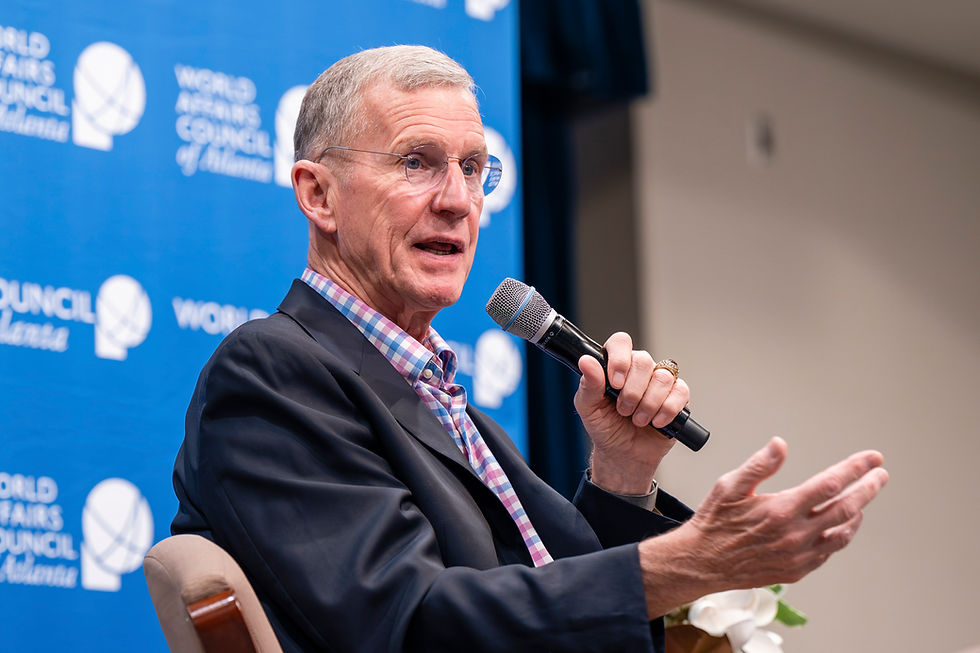
At a time when leadership is increasingly scrutinized and public trust increasingly fragile, the World Affairs Council of Atlanta convened a fireside chat with retired U.S. Army General Stanley McChrystal about his new book “On Character: Choices That Define a Life.” Council President Rickey Bevington led a searching conversation about character—not as an aspiration, but as a lived discipline shaped by decisions made under pressure.
From the opening moments, McChrystal pushed against any abstract or performative understanding of the term. “Character is who we are,” he said plainly. “At the end of the day, it’s the essence of us.” Citing Heraclitus—character is fate—and Thomas Paine’s distinction between reputation and character, McChrystal framed the discussion around one central idea: what truly defines a leader is not how they wish to be seen, but how they act when it matters.
“Reputation is what men think of us,” he said. “Character is what gods and angels know of us.”
Character Revealed in Action
For McChrystal, character is not demonstrated through speeches, writing, or stated intentions. “It’s reflected in what we do,” he emphasized, “not what we say, not what we write. It’s what we actually do.”
Those tests, he argued, arise in multiple forms: how leaders respond to unexpected hardship, how they treat people when they hold power, and how they behave when success creates temptation. “We have to test ourselves against how we reacted to the events of life,” he said, “and then how we were when we were on top of the world and we had the opportunity to exercise influence and power.”
McChrystal offered a concise definition he has come to rely on: character equals conviction multiplied by discipline.
“We all have conviction,” he explained—deeply held beliefs, not casual opinions. “But by themselves they don’t mean that much.” Without discipline—particularly personal courage—convictions never translate into action. “Anything times zero is zero,” he said.
How Character Is Formed
McChrystal described character not as a fixed attribute, but as a journey. He traced his own beginnings to his parents, who modeled integrity without ever preaching it.
“I never saw my parents—either of them—do anything wrong,” he recalled. “They never took a parking space they shouldn’t have. They never kept change they shouldn’t have from a store clerk.” What mattered most, he said, was not instruction but example: “They didn’t spend a lot of time talking to the six kids about character. They just lived it.”
That lived example was reinforced at West Point, where character formation was explicit and uncompromising. The honor code, McChrystal noted, set a deliberately high bar. “A cadet does not lie, cheat, or steal, nor tolerate those who do.” The purpose was not perfection. “The point was to try to plant inside every cadet a set of values that over a lifetime would grow and become your habit—who you are.”
The Defining Test
When Bevington asked when his own character was truly tested, McChrystal did not hesitate. “The biggest, most memorable for me came when I left the service.”
After 34 years in uniform, including command of U.S. and NATO forces in Afghanistan, McChrystal resigned following the publication of a Rolling Stone magazine article that portrayed his command team as contemptuous of senior civilian leadership. Though he disputed the accuracy, he accepted responsibility.
“I’m responsible. I’m in charge,” he said. “And an article came out that was a bombshell on President Obama’s desk.”
Returning from Afghanistan, McChrystal met with the president and offered his resignation. “If you want to accept it, I’m fine,” he recalled saying. “If you want me to go back and continue command, I’m fine—whatever’s best for the mission.” President Obama accepted it immediately.
“In a second,” McChrystal said, “I’m not a commander anymore. I’m not a general. I’m not even a soldier.”
That sudden loss of identity was disorienting. But the conversation that followed at home with his wife, Annie, set his course forward. When he told her the resignation had been accepted, she responded without hesitation: “Good. We’ve always been happy and we will always be happy.”
“She set a direction for me,” McChrystal said. “We had two choices… I could be a bitter old general who felt like he got a raw deal. Or we could face forward.”
They chose the latter. “We made a decision in that moment to face forward,” he said. “To live in ways that if people never met me before but read that article, they’d say, ‘Wow, that doesn’t seem like what I read.’”
Why Leaders Compromise
Bevington pressed McChrystal on why leaders sometimes abandon values they know are right. His answer was blunt: pressure, ambiguity, and rationalization.
“Sometimes what the right thing is … is not completely clear,” he acknowledged. Power amplifies uncertainty. “If you go into the Oval Office, the President has ultimate home field advantage,” he said. Leaders want to be loyal, to be helpful, to stay on the team. “You feel this tremendous gravitational pull.”
Rationalization, however, is where character erodes. “We put leaders in positions not simply to be a conduit,” McChrystal argued, “but to actually be leaders.” Without the willingness to stand up for values—without “leading with your chin,” but still standing—leaders abdicate their responsibility.
Metrics That Endure
McChrystal illustrated that point with a post-military example: resigning from a corporate board after shareholders reversed a decision not to claim disaster funds the company did not need.
“There are things that are right and that are wrong,” he said. His personal metric was simple.
“My three granddaughters… I don’t want them ever to have to go, ‘Why did Granddaddy do that?’”
Discipline as Habit
Discipline, McChrystal stressed, is sustained through habits and systems designed to prevent emotional decision-making. “Set yourself up so you’re not making decisions in moments of emotion,” he advised. Trusted people, structural checks, and longer time horizons all help.
A phrase he now lives by captures that approach: “Decades, not deals.”
Character, Citizenship, and Service
The conversation concluded with a broader civic argument. McChrystal described national service—military or civilian—as a crucial tool for rebuilding shared identity.
“The purpose is not what you do,” he said. “It’s who you become.” Contributing meaningfully creates ownership. “If you contribute to something, you feel like a shareholder of it.”
Without shared sacrifice, citizenship becomes passive. “Almost all of us are citizens by accident,” he observed. Service, by contrast, asks people to grow—through inconvenience, challenge, and responsibility.
A Lifelong Discipline
Near the end of the exchange, McChrystal returned to the opening theme. “I’m 71 now,” he said. “And I’m still working on my character.” It gets easier, he added, only because its importance becomes more obvious.
Character, in McChrystal’s telling, is neither static nor guaranteed. It is built slowly, tested unpredictably, and revealed decisively—in the choices leaders make when the stakes are highest and the consequences unavoidable.
Watch the event recording. YouTube
View the event photo gallery here. Flickr


Comments